Frederick Lawrence marries Esther Hargrave
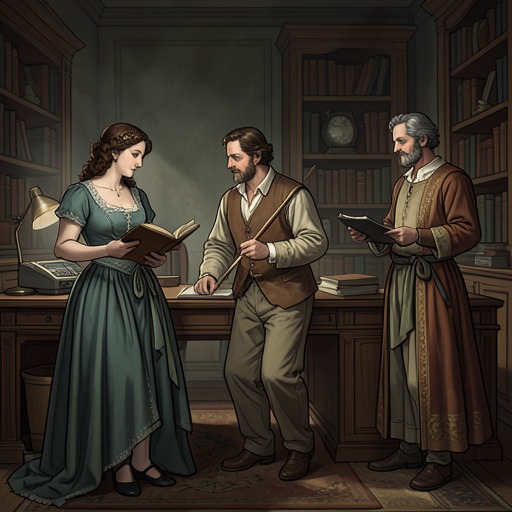
The Tenant of Wildfell HallFrederick Lawrence marries Esther Hargrave in a rural church near Grassdale, in a scene that first turns Gilbert Markham’s hopes into alarm and then corrects his mistaken understanding. Lawrence introduces his bride as Esther, formerly Miss Hargrave, and the wedding’s closing exchange links the couple’s happiness to their concern for Helen, whose marriage to Arthur Huntingdon remains unresolved.
Causes and Background
The marriage reaches Gilbert first as uncertain neighborhood news. Eliza Millward tells him that Helen is said to be marrying on the following Thursday and that Mr. Lawrence has gone to the wedding. Her information comes through several people: Sarah, an informant, and a footman. Eliza admits that she cannot vouch for the report and does not remember the bridegroom’s name. The rumor is therefore both tantalizing and unreliable, but it is enough to send Gilbert toward Grassdale in haste.
The misunderstanding has emotional force because Gilbert still loves Helen and fears that she is about to marry someone else. His arrival at the church is shaped by the expectation created by the report, not by confirmed knowledge of the ceremony. The wedding thus becomes a test of what he believes about Helen as well as an occasion for discovering Lawrence’s private good fortune.
The Wedding and Recognition
Gilbert reaches the little church near Grassdale to find carriages outside and villagers gathered to watch the wedding. He cannot tell from the crowd how the ceremony is proceeding, and waits rather than entering or leaving. When the couple comes out, he initially focuses on the bride and takes her for Helen. The woman is not Helen, however, but a younger bride whom Gilbert does not recognize.
The groom is Frederick Lawrence. Seeing him resolves the central uncertainty: the wedding is Lawrence’s, not Helen’s. Lawrence recognizes Gilbert despite his altered appearance and introduces the bride as his wife, Esther Lawrence, formerly Miss Hargrave. His attempt at casual composure carries an air of embarrassment alongside evident pride in the woman beside him. Gilbert responds by greeting Esther and warmly clasping Lawrence’s hand, turning the moment from imagined loss into a reunion with his friend.
Esther and Lawrence’s Relationship
The wedding’s brief private exchange presents Esther and Lawrence as mutually affectionate. As they are together in the carriage, Esther jokes that she could not manage the tears customarily expected of a bride. Lawrence answers with a kiss and notices that she is crying after all. Esther explains that the tears come from happiness, joined to a wish that Helen were as happy as they are.
Esther’s concern reaches beyond the celebration of her own marriage. Her thought turns to Helen, whose difficult attachment to Arthur Huntingdon has left her without the secure happiness that Esther and Lawrence appear to share. Gilbert silently blesses Esther for the wish and hopes that it may not be entirely futile. The scene offers no immediate resolution for Helen, but makes her welfare part of the newly married couple’s emotional world.
Consequences and Narrative Significance
The wedding corrects a rumor that has briefly made Gilbert fear Helen is marrying another man. Its revelation is not that Helen has entered a new marriage, but that Lawrence has married Esther, whom Gilbert knows as Miss Hargrave. The distinction matters: Gilbert’s fear gives way to relief, while the ceremony confirms that Lawrence’s personal life has moved forward without ending Gilbert’s uncertainty about Helen.
The event is presented retrospectively by Gilbert within his account to Halford, so the reader encounters the report, Gilbert’s expectation, and the church scene as stages in a single unfolding correction. Esther’s final wish keeps the conclusion from becoming uncomplicated celebration. The newlyweds possess the happiness she hopes Helen may one day share, while Gilbert leaves the scene still facing an unknown future with the woman he loves.